
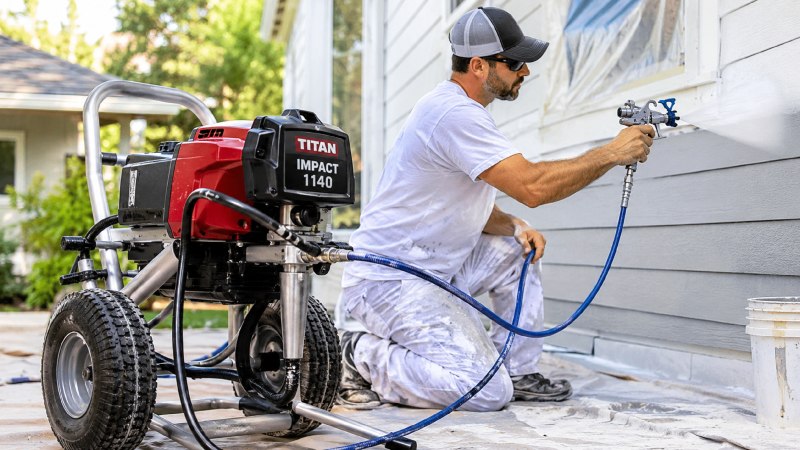
Every painting company hits the same wall at some point. The sprayer that carried the business through its first few years starts to feel small. Jobs get bigger, crews get bigger, and suddenly you are waiting on the machine instead of the other way around. That is usually the moment people start looking at the larger end of the Titan Impact line, and the Impact 1140 comes up quickly in those conversations.
This review is not a spec sheet recital. Specs matter, and you should always check them against the manufacturer’s current literature, but they rarely settle the question by themselves. What settles it is how your crew actually works, what you spray, and what a day of downtime costs you. Let’s walk through the decision the way an experienced estimator would.
Start with the work, not the machine
Before you look at any sprayer, write down what a typical week looks like. How many gallons do you go through? Are you mostly spraying walls and ceilings in new construction, repainting occupied buildings, or coating exteriors? Do you run one gun or two? Do you ever stack tall lifts on the same hose?
A larger electric airless sprayer earns its keep when volume and run time are high. If your crew sprays most days and regularly runs large tips or multiple guns, the extra capacity pays for itself in fewer pauses and less strain on the pump. If you spray a few days a month on small interiors, a smaller machine will serve you better and cost far less to own.
What makes the Impact 1140 a different kind of purchase
The Impact 1140 sits in the heavier tier of the Impact family. You can see how the machine is put together in the Titan Impact 1140 parts diagrams at AllTitanParts, which split the machine into nine groups, from the main assembly to the drive, filter, fluid section and cart options.
That breakdown is more useful than it looks. When you are deciding on a big machine, the structure of its parts catalog tells you a lot about what ownership will feel like. A well documented machine with clear assemblies is easier to maintain, easier to repair on your own schedule, and easier to keep alive for years.
Two cart styles, and why it matters
One detail that surprises buyers: the 1140 is documented with two cart arrangements. There is an upright cart assembly and a low rider cart, and the low rider has its own siphon assembly.
Why should you care? Because the cart determines how the machine lives on your job sites. An upright cart is easier to roll across a floor and stand beside a bucket or drum. A low rider keeps the center of gravity down, which some crews prefer on stairs, ramps and uneven ground. Neither is better in every case. Think about where your machine travels, how often you load it into a truck, and how many people lift it.
The parts that decide your long term cost
Every airless sprayer has the same few parts that wear: packings, valves, filters, tips and hoses. On the 1140, these live mainly in two places. The Impact 1140 fluid section assembly, listed under P/N 805-246A, holds the pump parts that move material. The filter assembly, listed under P/N 805-269A, protects the tip and gun from debris.
If you plan to run this machine hard, take a minute to look at those two diagrams before you buy. You are looking for two things. First, can you get replacement parts easily? Second, do the assemblies look like something your shop could service without special tools? For the 1140, parts are readily documented and available, which is a quiet but important point in its favor.
Total cost is more than the sticker price
New buyers fixate on the purchase price. Experienced owners think in cost per working day. A sprayer that costs more up front but runs reliably for years often beats a cheaper one that needs a repair every season. Run a simple calculation. Estimate how many days a year the sprayer will work, add the cost of routine parts such as packings, filters and tips, then add the cost of one lost day for every unplanned repair. The result is usually more favorable to the bigger machine than people expect, but only if you actually use that capacity.
If you do not use the capacity, the math flips. You are paying for performance you never touch, and you are hauling a heavier machine around for no reason.
Who should buy it
The 1140 makes the most sense for a company that:
- Sprays most working days and measures usage in many gallons a week.
- Runs larger tips or more than one gun from the same machine.
- Has crews that include several people competing for sprayer time.
- Wants a platform that can be maintained and repaired with a documented parts system.
- Values uptime enough to keep a few spare wear parts on the truck.
Who should think twice
You might want to look at a smaller Impact model, or even a different class of equipment, if you:
- Spray occasionally and mostly on small interior jobs.
- Rarely run large tips.
- Work alone or with a small crew.
- Move your sprayer in and out of a small vehicle several times a day.
There is no shame in choosing the smaller machine. Many professionals do their best work with a sprayer that fits their pace. For a quick tour of the whole range, the Titan Impact sprayer parts catalog lists every model, from the 340 up through the 1640, so you can compare where the 1140 sits.
Buying smart: new, used and rental
If budget is tight, you will see used machines. They can be a good value, but treat them carefully. Ask for the model plate, find out which cart style it has, and check the fluid section for leaks. Look closely at the drive assembly and ask about service history. A neglected pump can add a surprising amount to your total cost.
Renting a larger machine for a trial job is another option. A few days of real work will tell you more than any brochure. If it eliminates delays and makes your crew visibly more productive, you have your answer.
Plan your spares before the first job
Whichever route you take, build a small spare parts kit on day one. Include a set of packings or a repair kit for the fluid section, extra filters, a couple of tips in your common sizes and a spare hose or whip hose. These items cost little compared with an idle crew. You can browse the full Impact 1140 main assembly and the drive assembly to see what else is documented.
A five minute check that protects a big machine
A larger sprayer rewards a short daily routine more than a small one does, simply because every part on it costs more to replace. Before the first trigger pull of the day, walk around the machine once.
- Look at the top of the pump for paint weeping past the packings and add piston lubricant as the manual directs.
- Check the suction tube and its strainer for dried paint, cracks and loose connections.
- Open the filter housing on a regular schedule and rinse the element instead of waiting for the pattern to suffer.
- Run a hand along the hose for bulges or soft spots, and confirm the couplings are tight.
- Listen to the machine as it builds pressure. A change in sound is often the first warning you get.
None of this takes long, and it changes how the machine ages. Crews that do it tend to replace packings on their own schedule, on a slow afternoon, with the kit already on the shelf. Crews that skip it tend to replace them on the busiest day of the month. It also helps to give the sprayer one owner. When a single person is responsible for cleaning, lubricating and logging service on the machine, small problems get noticed while they are still small, and the next operator never inherits a surprise. A short note taped inside the cart lid, listing the last service date and the tip sizes in use, is enough to keep everyone informed.
The bottom line
The Titan Impact 1140 is a serious tool for companies that spray a lot. It is not a bargain machine and it is not meant to be. It is meant to be the sprayer you stop thinking about, because it keeps working while the crew keeps painting. If your weekly gallons, tip sizes and crew size line up with that picture, it deserves a close look. If they do not, a smaller model will probably make you happier and keep more money in your pocket.
Whatever you decide, do the homework on parts and service before you buy, and keep your spares stocked. Machines rarely fail at a convenient time, but a good plan makes the inconvenient moments short. Click here see more details.