
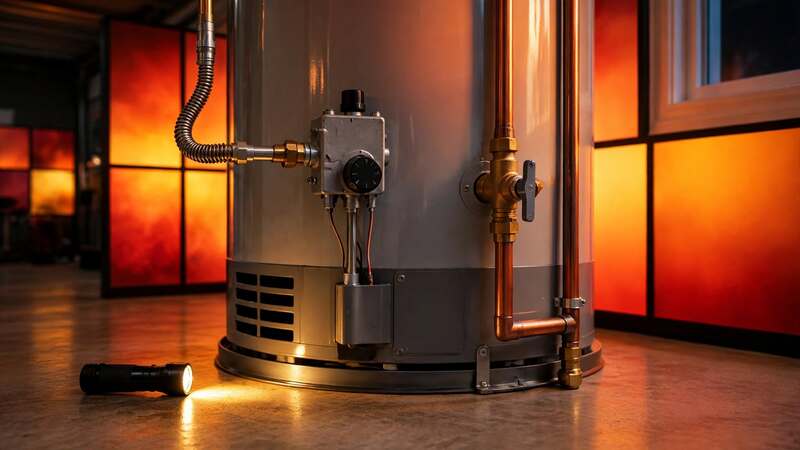
Ask most people what builds up inside a tank water heater and they’ll say “hard water.” That’s part of the story, but not all of it. Utility data puts Greenville, South Carolina at roughly half a grain of hardness per gallon, which is very soft, and county-wide sampling puts nearby Greer at about 0.7. Tanks in soft-water areas still collect material at the bottom. What that material is matters, because the different kinds behave differently.
Four different things
“Sediment” is a catch-all. A tank bottom can hold any mix of these.
Silt and loose debris. Fine particles that arrive with the water supply and settle out. InspectApedia notes that silt can cause problems similar to scale even where water isn’t hard, and that it can be flushed out, especially before it hardens.
Scale. Mostly calcium and magnesium carbonate. Heat pushes these minerals out of the water, and the deposit bonds to the metal. Once hardened, it doesn’t flush out. It has to be scraped or dissolved with a de-liming product.
Rust and corrosion flakes. Pieces of the tank interior or fittings. Rheem points out that mineral-heavy water can speed up internal corrosion, and the anode rod is there to slow it.
Aluminum hydroxide gel. InspectApedia’s author describes a rumbling that can come from this gel when the water’s pH is 8 or higher and the tank has an aluminum anode. His rule of thumb is that it shows up within about six months of installation, while scale noise usually takes a year or more. That’s one writer’s observation, not a standard, but it’s a useful clue when a new tank rumbles.
How it builds over the years
Nothing dramatic happens at first. Each heating cycle leaves a little behind and the layer thickens slowly. Early on there’s usually nothing to notice. Later the heater may start to pop or rumble while it heats. How fast this goes depends on the water, how much hot water the household uses, and the thermostat setting. Rheem suggests keeping it between 120 and 130 degrees Fahrenheit to slow scale formation.
What it actually does
Some effects are well supported. Others are less certain, and a few are exaggerated.
Well supported: the layer acts as insulation. Rheem says it lengthens heating cycles, uses more energy, and puts extra strain on elements and burners. On electric heaters, scale on the elements reduces heat transfer and shortens element life. On gas units, scale on the tank bottom insulates it, so the metal runs hotter than it otherwise would.
Plausible but less certain: that the hotter bottom of a gas tank weakens over time. InspectApedia presents the idea that this could contribute to catastrophic failures as a possibility, not an established fact. Corrosion remains the usual reason tanks eventually leak.
Exaggerated: any single figure for lost efficiency. Rheem cites “up to 30%,” but that’s a manufacturer’s number with no independent testing cited, so treat it as a ceiling and not an expectation. Sediment alone also isn’t a reason to expect a sudden failure.
Gas and electric differ in where the trouble lands. A gas burner heats from underneath, so the effect shows at the tank bottom. An electric heater’s lower element can become coated or buried, and that’s usually where problems show first.
What the sounds can mean
A pop or rumble while the heater runs is the classic sign of a layer on the bottom: water trapped beneath it flashes to steam and works its way up. It isn’t the only possible cause. InspectApedia also lists abrupt water flow stops and, on gas heaters, condensation dripping onto the burner, which crackles. Ticking is often pipes expanding, not the tank. Hissing or sizzling from the bottom deserves attention, since it can mean water reaching something hot.
Hot water that runs out too soon isn’t proof of sediment either. A failed element, a thermostat fault or a damaged dip tube can produce the same symptom, which is why a technician checks several things before blaming the tank.
What a technician typically checks
Exact steps vary, but these come up again and again.
The drain: what comes out, whether clear water, fine grit, flakes or chunks, and whether the valve opens and closes properly. Rheem and A. O. Smith both say a valve that won’t open or leaks is a reason to call a professional.
The anode rod. A. O. Smith recommends inspecting it yearly and replacing it if it’s deteriorated or has several inches of core wire showing. A healthy rod is about half an inch thick, and wear depends on water chemistry, hot water use and whether a softener is installed.
The temperature and pressure relief valve. A. O. Smith advises a yearly lever test by the homeowner and a professional check every five years. A dripping valve often points to high water pressure or thermal expansion, which can call for an expansion tank and not a new valve.
The age on the data plate. Rheem lists 8 to 12 years and older as the point where a professional evaluation makes sense.
Maintenance, and its limits
Manufacturers recommend flushing. A. O. Smith says at least once a year, and Rheem says every six months where water is hard. The routine is to shut off the power or gas and the cold water supply first, then drain to a safe place.
Flushing has limits. It carries away loose silt but not hardened scale. It can’t repair a stuck drain valve. And a water softener, while it cuts scale, affects how fast the anode rod wears, so with a softener it makes sense to inspect the rod more often.
When flushing an old tank needs a professional
A tank that has never been flushed, or has popped and rumbled for years, is a different case from one with a light layer. Rheem warns that flushing hardened buildup in older or long-neglected units yourself “could lead to leaks or further damage.” If the drain valve won’t open, if there’s rust or dampness around the fittings, if the noise continues after flushing, or if the tank is in the 8 to 12 year range or older, a hands-on assessment is the safer route. A local specialist offering water heater repair in Greer can look at the tank, the valve and the rod in person and tell you whether cleaning it out is still worthwhile.
One safety point applies at any age: if you smell gas near a gas water heater, leave the house and call your gas utility or 911 from outside.
Sources referenced: Rheem (flushing and hard water guides), A. O. Smith (water heater maintenance guide), InspectApedia (water heater noises), and Tapwaterdata (South Carolina water hardness). Click here see more details.